International outreach · Flagship initiative
The Negev Bi-Literacy Initiative: Teaching Negev children to read in Hebrew and English — together, from the very beginning.
One method, two languages, in schools across the Negev and beyond. Launching at Israel EdTech Week in partnership with:

What a school receives
Everything a school needs to teach literacy in two languages well, for every class from kindergarten through grade six, at no cost to the school.
Virtual professional development for all teachers
Continuous Virtual implementation coaching
Progress Monitor and ongoing data reporting
Funded teacher stipends, so teachers are paid for their training time
CAPIT Reading in Hebrew and English for every student and educator through our partnership with Capit Learning
School recruitment and on-the-ground support through our partnership with MindCET
We look for two things in a school: a leader with a vision for change, and staff who are excited to try something bold and new to impact student outcomes.
How our grant works
SPARK Funds the Teachers
Our grants cover teacher professional development, implementation coaching, and stipends that pay teachers for their training time.
CAPIT Grants the Curriculum
Capit Learning provides platform access to CAPIT Reading through its own grant program, the CAPIT Reading Grant.
A Single Application
Schools fill out one application through SPARK Literacy Foundation, and it covers licenses, training, coaching, and stipends.
SPARK is an independent nonprofit founded by the founders of Capit Learning. Capit Learning grants access to the CAPIT Reading program; SPARK funds the teachers.
About the curriculum
CAPIT Reading uses the Sound-to-Print method (Linguistic Phonics). It teaches reading starting from the speech sounds children already know, not from letters.
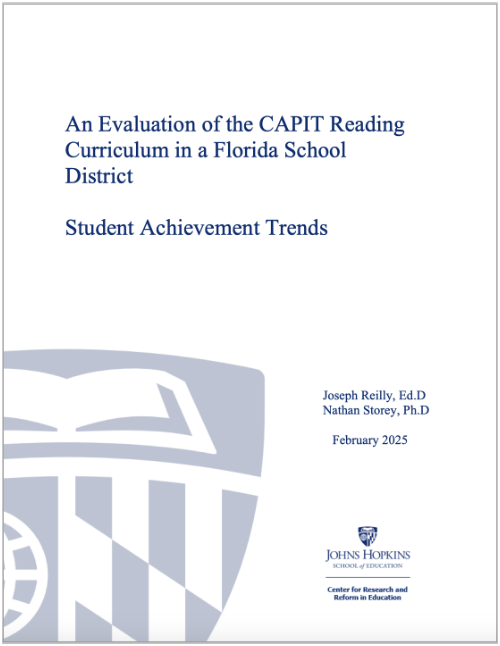
Validated by Johns Hopkins University School of Education
ESSA Tier 2 evidence rating
2026 Language & Literacy Award Winner, Global EdTech Startups Awards at Bett UK for innovation in language and literacy instruction.
Why it matters
Israel's reading scores are falling. In PIRLS 2021, Israel scored 510 — a 20-point fall against a global average decline of 8, leaving it 30th among OECD countries. Among Hebrew-speaking students, the drop was 28 points. The share of children reading at a high level fell by 11%; the share reading at a low level rose by 8%. Israel's Education Ministry put it plainly: reading has returned to where it stood in 2001.
None of that is because Hebrew is hard to read. Pointed Hebrew is one of the most transparent writing systems in the world — the vowel points make sound-to-symbol correspondence almost perfectly regular, far more consistent than English.
This is a method problem, not a language problem.
Israeli schools don't begin teaching children to read English until third grade. Yet English is economic infrastructure in Israel: in 2025, high-tech accounted for 18.3% of GDP and 58% of all exports. In wealthier communities, families fill the gap with private tutors and enrichment programs. In the periphery, most families can't, so their children fall furthest behind. It doesn't have to be this way. Research shows that young children can start reading in English early without hurting their Hebrew. Phonological awareness and decoding transfer between languages, so reading skills built in one language can help build skills in the other. Reading in Hebrew makes English easier, and reading in English strengthens Hebrew. The two languages support each other. They don't compete.

Figures from PIRLS 2021, published by the IEA in May 2023. Hebrew-speaker and achievement-band figures via Ynet; OECD ranking via The Jerusalem Post. Economic figures from the Israel Innovation Authority's 2026 State of High-Tech report. On cross-linguistic transfer: Melby-Lervåg & Lervåg (2011), Journal of Research in Reading 34(1), 114–135.
A pilot in Yerucham
In spring 2026, first graders in a Yerucham elementary school began reading English two years earlier than Israeli schools normally do. In a short pilot, during a war, every child showed growth, and some began reading independently.
They are six-year-olds in a development town in the desert. Most had never seen an English letter. Their teachers had never taught reading this way before, and they learned the method while the country was at war. Within weeks, the children were sounding out words in a language the system says they should not meet until third grade.
That is the whole idea, and it is why we are not waiting. Every year a child spends waiting is a year spent behind.

An independent evaluation will be published here when it is available.
Why the Negev
The Negev holds the widest range of circumstances in Israel — Bedouin, Arab, Gaza-envelope, and Jewish schools across the resource spectrum — at a scale small enough to work with closely. From kibbutz schools to some of the most under-resourced Bedouin communities in the country.
Yerucham | Ramat Negev | Meitar | Tel Sheva | Neve Midbar
We work there with MindCET, an Israeli educational innovation organization based in the Negev, born out of CET. MindCET recruits the schools and is our partner on the ground; its Negev EduLAB is built to run exactly this kind of matched-school, field-measured initiative.
FOR FUNDERS
Adopt a school in the Negev
Every adoption funds teacher training, teacher stipends, and implementation coaching for a school's kindergarten-through-sixth-grade classrooms.
$1,800
Adopt a Preschool
A stand-alone preschool with up to 3 classes.
$5,000
Adopt a Small School
A school with up to 8 kindergarten-through-sixth-grade classrooms.
$8,000
Adopt a Large School
A school with 9 or more kindergarten-through-sixth-grade classrooms.
You'll know your school. Every adopter is matched to a school. As schools join the initiative, you can choose yours, or we'll assign you one, and you'll hear what the teachers are teaching and what the children are learning.
While our 501(c)(3) determination is pending, gifts to SPARK Literacy Foundation are received through our fiscal partner, Friendship Circle of Los Angeles, a registered 501(c)(3). Your receipt will come from Friendship Circle of Los Angeles, thanking you for supporting this project. Gifts are tax-deductible to the extent allowed by law.