Sound-to-Print
Reading starts with the sounds children already know
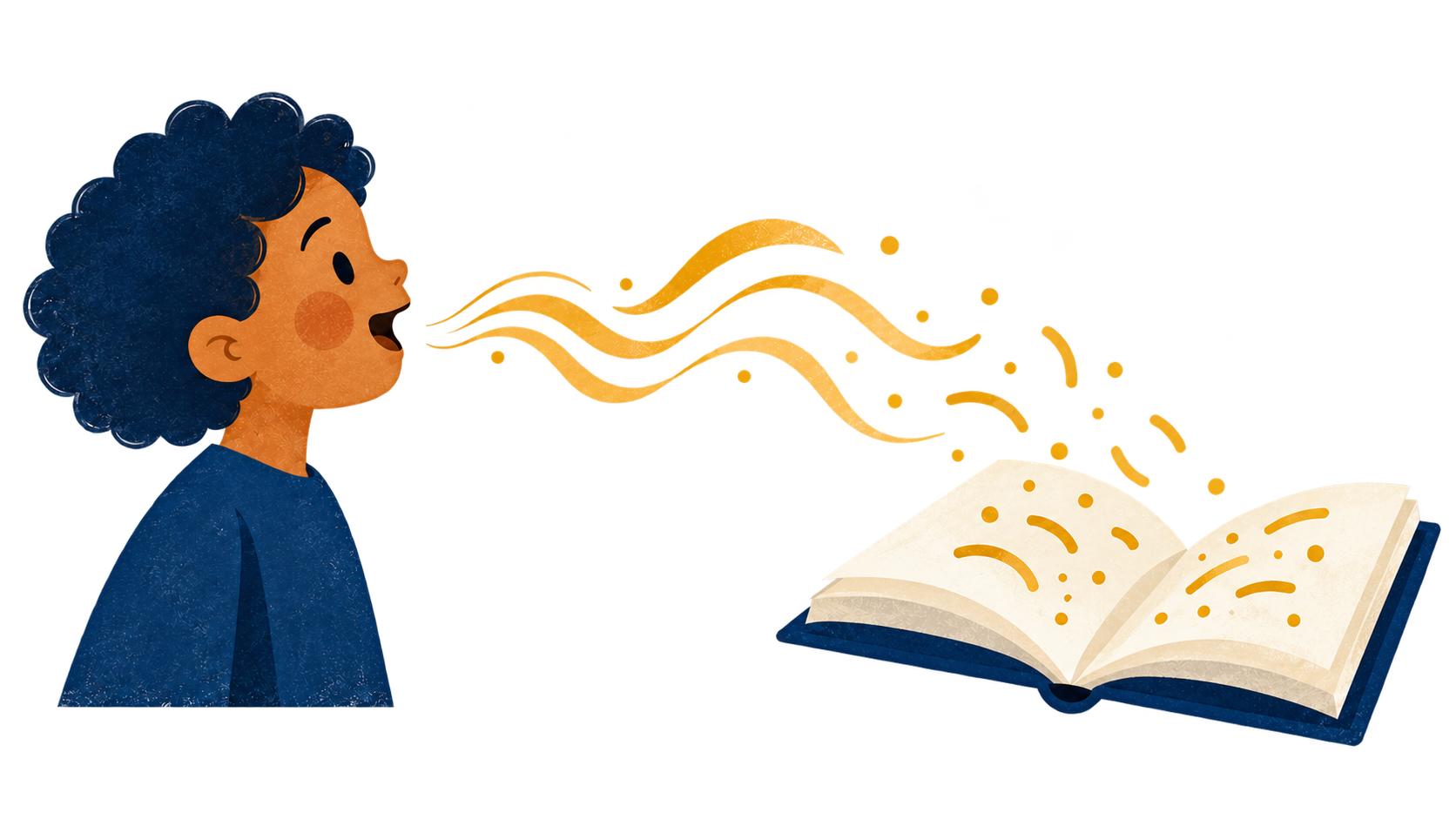
Every child who can talk already knows—implicitly—the sounds of their language. Sound-to-Print teaches reading from there. Children learn that writing is a code for speech, and that each letter or letter group stands for a sound they already say every day.
A different starting point
Most early reading instruction starts with print. Children see a letter, learn its name, and are told the sound it "makes." Then come rules, exceptions, and lists of words to memorize by sight.
Sound-to-Print turns that around. It starts with speech. There are 40+ sounds in spoken English (and 25 sounds in spoken Modern Hebrew). Writing is simply a way to record these sounds. Once children understand that, print stops being a pile of rules and becomes a system they can figure out.
Letters don't make sounds—people do!
The core ideas
Sounds come first. Children learn to identify the sounds in words, then learn how each sound is written. The sound always remains primary.
Print is a code. Each sound can be written in one or more ways. Children learn the code as a system that makes sense, not as a list of rules and exceptions to memorize.
Reading and spelling are the same skill, running in both directions. Sound-to-Print teaches students that the alphabetic code is a reversible code, so decoding (reading) and encoding (spelling) are taught together from day one.
Nothing to memorize by shape. Even "tricky" words are made of sounds and spellings. Children decode them instead of guessing.
Why this matters for the children we serve
When reading is taught as a set of rules and exceptions, many children become confused and fall behind. For most, it's not a lack of ability. They were never shown how the code works. Some catch up because a parent or tutor fills the gaps at home. Many do not.
Those children are far more likely to be in under-resourced schools. By the time they are flagged for help, they have already lost years of confidence and learning.
Sound-to-Print is built for prevention, not intervention. Teach the code clearly in the early grades, and fewer children need rescuing later.
The research behind it
Sound-to-Print, also known as Linguistic Phonics, grows out of the research of psycholinguist Diane McGuinness. Her work showed that the best way into an alphabetic writing system is the way the alphabet was designed: sounds first, symbols second.
For a full explanation of the method, see What is Sound-to-Print?, Why Our Children Can't Read (1997), Early Reading Instruction (2004).
Beyond English
Every alphabetic language records speech sounds. That's why Sound-to-Print works across languages, and why it fits bilingual classrooms so well. Our Negev Bilingual Literacy Initiative brings this approach to children learning to read in two languages at once: Hebrew and English.
Learn about the Negev Initiative →
Bring Sound-to-Print to your school
SPARK funds teacher training, coaching, and stipends for schools that serve the children who need it most.